

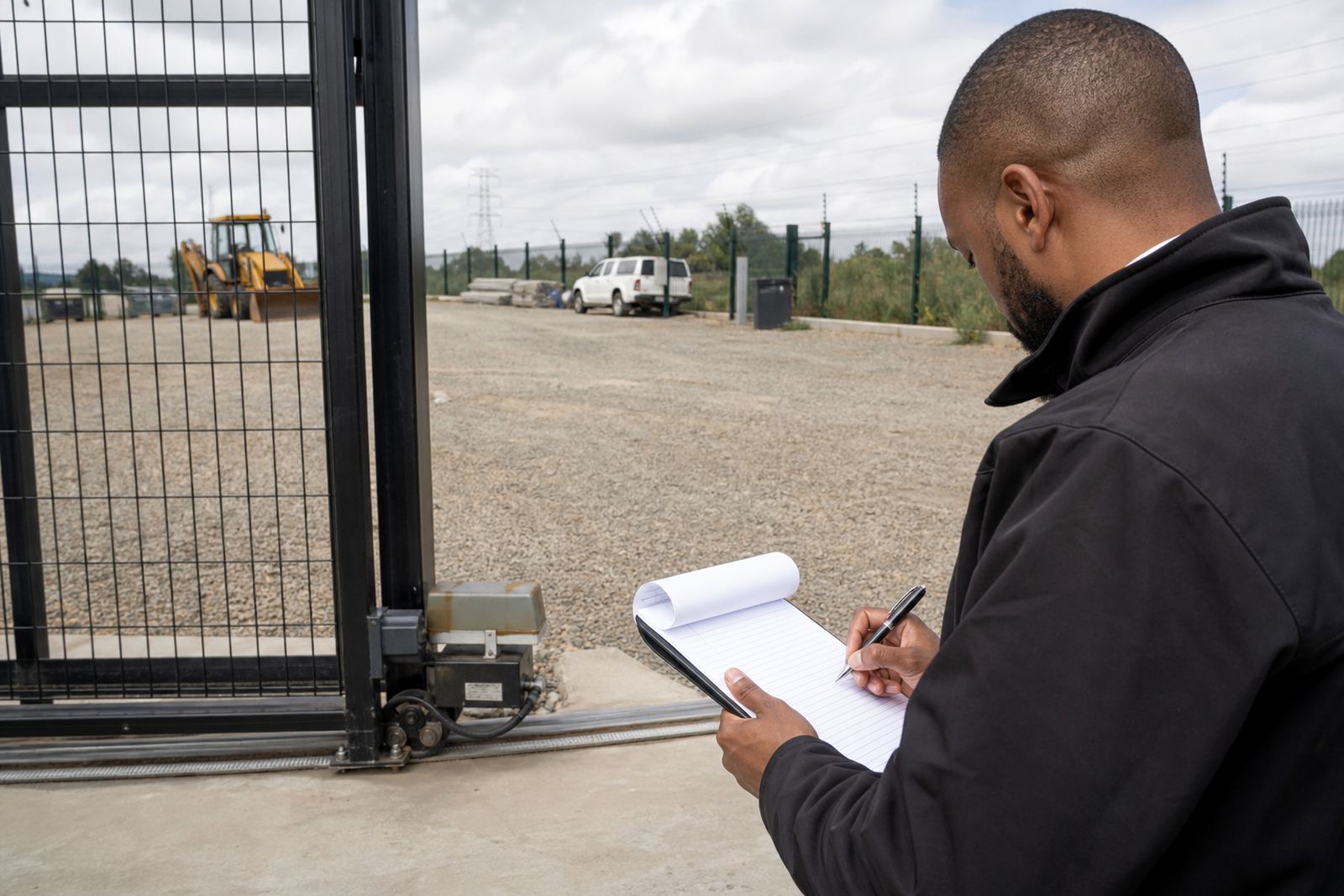
What a proper yard check should confirm
An industrial yard check is not just a drive past and a few photos. It should test whether the site is occupied as described, whether the boundaries are clear, and whether the property use on the ground lines up with the title and municipal records. For lenders and buyers, that matters because an open hardstand can hide storage issues, informal occupation, shared access or unrecorded structures.
In places like Centurion, Midrand and Johannesburg, yards are often used for logistics, construction storage, fleet parking or light manufacturing support. On the Cape side, coastal humidity can affect fencing, containers and stored stock, while in Durban a yard close to port-related activity may have heavier vehicle movement and stricter access control. The point is simple: the site should be checked in person, not assumed from a file.
Access, perimeter and gate control in real conditions
Industrial sites live or die by access. A clean title search is useful, but if a truck cannot enter safely, or if a neighbouring tenant crosses the boundary daily, the risk profile changes fast. Field verification should confirm entrances, turning space, gate control, walling or palisade condition, and whether there is enough room for loading without blocking a public road.
- Check who controls the gate and whether access is shared.
- Measure the yard surface for heavy vehicle movement and loading bays.
- Look for damaged fencing, broken locks or unauthorised openings.
- Confirm if the property sits on a corner stand, servitude or access strip.
- Note signs of overnight parking, skip storage or informal dumping.
In some municipal areas, poor access also creates compliance headaches if trucks are reversing into the street or if loading spills onto road reserve. That can trigger neighbour complaints, by-law attention and practical delays for an incoming operator.
Occupancy checks that show how the yard is actually used
Many industrial yards are occupied in ways that are not obvious on paper. A property may be described as vacant, yet still hold stock, plant, containers, or a tenant running a side operation from the same space. Occupancy checks help confirm who is there, what they are doing, and whether that use is lawful under the current agreement or zoning.
A good check should note the number of vehicles on site, the presence of guards, office cabins, storage units and any sign of split occupation. It should also identify whether the site appears owner-occupied, leased, or partly sublet. In one Pretoria industrial case, a buyer was prepared to proceed on the strength of a neat rent roll, but the site visit showed two separate operators using different sections of the yard with no clear boundary. That changed the conversation quickly, because the operational risk was higher than the file suggested.
- Count vehicles, containers and movable assets on site.
- Record whether staff, guards or contractors are present.
- Check for tenant names on gates, signage or paperwork on display.
- Note whether the yard is functioning full time or appears dormant.
Records that need to line up before the money moves
Industrial yard checks are strongest when the physical visit is tested against records. Ownership should match the property description, the erf size should make sense, and any document gaps should be flagged early. If a transaction file contains an old lease, missing rates statements or a mismatch in the improvements shown on the ground, that is not a minor admin issue. It can affect pricing, finance, and transfer timing.
Buyers and lenders should ask for a document gap review where needed, especially on larger depots or older industrial holdings in older parts of Cape Town, Bloemfontein and Johannesburg. Where the property is part of a wider portfolio, the site visit should also sit alongside portfolio risk mapping so the lender can see if the same owner has repeated issues across several sites. In practical terms, this helps avoid funding a yard that looks clean in one file but carries unresolved matters elsewhere.
Local red flags in depots, hardstands and storage yards
Some red flags show up again and again in South African industrial properties. A yard may appear busy, but the activity is not always tied to the registered owner or tenant. In other cases, the land may be used well, yet the structures, fencing or surface condition point to deferred maintenance and hidden cost. A lender should know this before issuing finance, and a buyer should know it before making an offer.
- Mixed use that does not match the zoning or lease terms.
- Unrecorded structures such as site offices, sheds or containers.
- Poor stormwater runoff, pooling or erosion on hardstand areas.
- Evidence of fuel storage, waste handling or hazardous material without controls.
- Signs that the site is under-used, occupied informally or partly abandoned.
For yards in places like Durban and the East Rand, moisture and heavy traffic can shorten the life of paving and perimeter systems. Near the coast, corrosion can set in fast if there has been no maintenance. These are not cosmetic issues. They affect operational continuity, security and replacement cost.
A Pretoria yard example that shows why field verification matters
Consider a buyer looking at an industrial yard in Pretoria with a neat layout, good access and a healthy-looking tenant profile. The paper file showed one operator and a long lease. On site, however, the field verification team found a second group using part of the yard for vehicle storage, with no obvious boundary and no visible lease record. The gates were controlled by one party, but the rear section was being used by another. That small detail changed the risk picture materially.
The buyer was able to go back to the seller with specific questions on occupancy, access rights and who held responsibility for the rear section. In a market where time pressure is common, that sort of fact finding can save months of trouble. It also shows why industrial yard checks should combine site visit verification, ownership verification and transaction file audit rather than treating each step on its own.
How buyers and lenders can use the report before proceeding
For a buyer, the report should answer one practical question: does the yard do what the seller says it does? For a lender, the question is similar but stricter: does the site present the risk expected for the advance being made? When both parties have clear information, there is less room for surprise after signature.
Industrial yard checks are most useful when they are ordered early, before final pricing or credit approval. That gives time to follow up on adverse media, ownership conflicts, document gaps and site inconsistencies. In Centurion and across South Africa, from Pretoria and Sandton to Cape Town, Durban and Bloemfontein, the same principle applies. Check the ground, check the records, and only then move ahead.