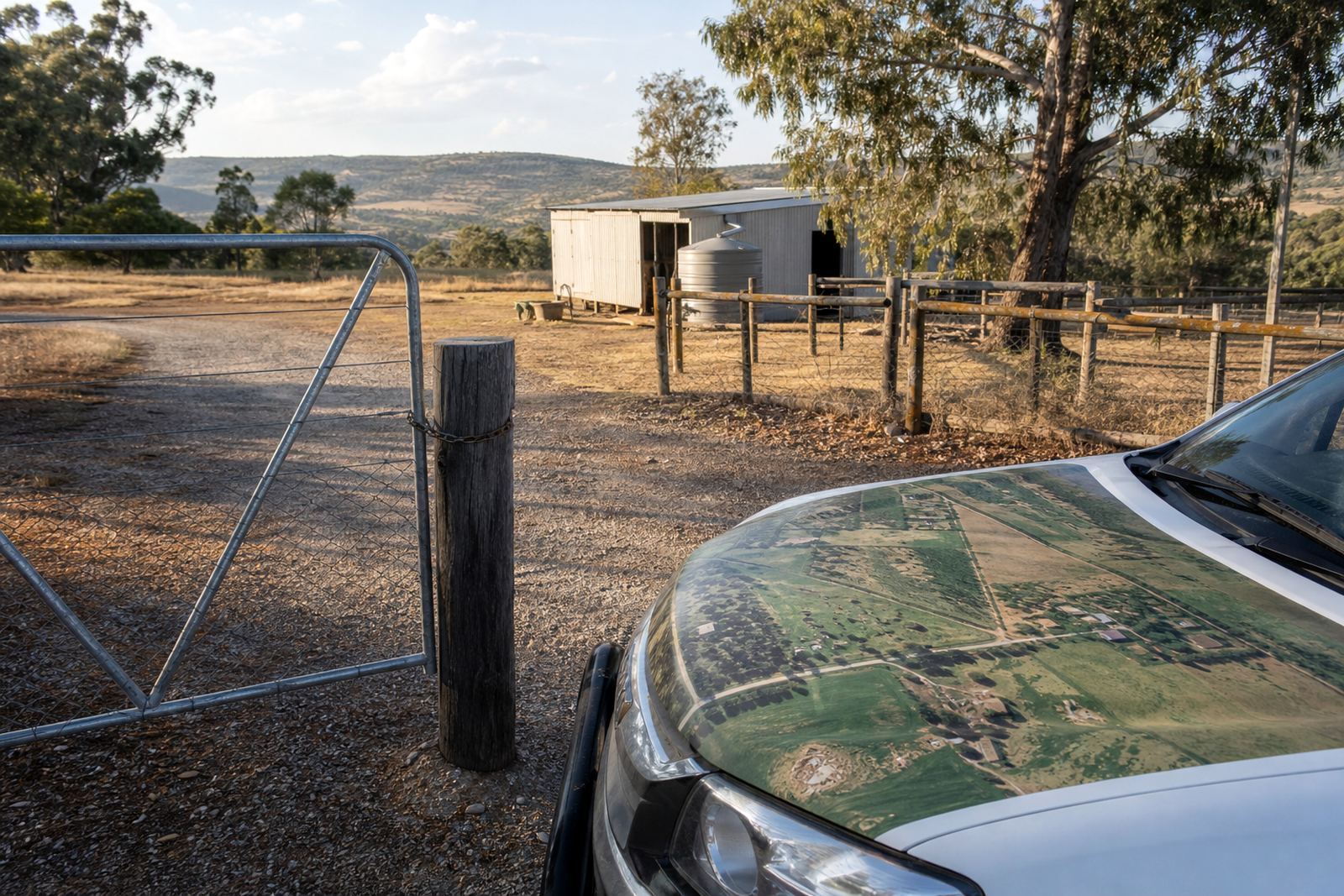
What the Agri Property Report covers
This report is built for farm purchases, smallholdings, lifestyle farms and agricultural units with land, water rights, sheds, workers housing or mixed-use structures. It pulls together the practical issues that matter before transfer, finance approval or a deposit is paid. You get a written due diligence summary that helps you compare the property against the seller’s story and the supporting papers.
Typical checks include title and ownership verification, seller authority, recorded bonds or restrictions, land use indicators, occupancy, visible site findings and document gaps. Where needed, we also look at company or trust ownership links, adverse media, and whether the transaction file holds together. It is especially useful when the land is remote, the structures are old, or the purchase depends on a specific operational use such as crop production, livestock, packing or storage.
The report is not a valuation and it does not replace a surveyor, engineer or agricultural specialist. It does however give you a neat, practical risk picture before you commit. That can save time, and a lot of aggravation when the paperwork is thin or the property is not what the brochure said.
Who uses it and where it fits
We prepare these reports for private buyers, banks, credit providers, attorneys and businesses buying agricultural land anywhere in South Africa. We work across Pretoria, Johannesburg, Centurion, Sandton, Midrand, Cape Town, Durban and Bloemfontein, and we also handle outlying rural areas where access roads are poor and mobile signal is patchy.
The report suits transactions where the property has to be checked for finance, family trust purchases, new farming operations, redevelopment, leaseback arrangements or security for lending. It is also useful when the land is partly occupied by tenants, labourers or third parties, or where the property has a mix of agriculture and residential use. In coastal areas, we pay attention to corrosion, damp and maintenance issues. In dry inland areas, water supply, boreholes and storage become more important than fancy finishes.
- Buying a farm, smallholding or grazing land
- Funding an agricultural purchase or land-backed loan
- Checking land held in a company, trust or close corporation
- Assessing occupancy, access and visible site conditions
- Reviewing a file before transfer, refinance or restructure
Report sizes and the level of detail you can choose
We keep the format practical. You can order a standard due diligence report for a single property, or a broader file review if the deal involves several holdings, related entities or multiple title deeds. A more detailed scope can include site verification, document gap review, adverse media research and portfolio level risk mapping where the buyer or lender is looking at several farms at once.
For a straightforward purchase, the standard report is usually enough. If the land has unusual zoning, a history of disputes, informal occupation, servitudes, water access issues or a layered ownership structure, it is better to ask for the expanded version. That way the report covers the bits that tend to get missed, like access over neighbouring land, unclear occupation arrangements, or whether the person signing is actually authorised to do so.
- Standard report: ownership, title, seller authority and core risk checks
- Expanded report: adds site visit verification, occupancy checks and document review
- Portfolio option: compares several properties for lender or investor use
- Custom option: focuses on a specific risk area such as water, use or occupancy
Key specs for agricultural property due diligence
The exact scope depends on the property and the papers available, but the report is structured so the main risks are easy to find. We check the property record, ownership trail, supporting documents and the practical condition of the site where access is possible. For farming-related purchases, this often includes land use clues, worker accommodation, fencing, storage structures and signs of ongoing activity or neglect.
Where site access is arranged, our field verification lead records visible conditions and any mismatch between the property description and what is actually on the ground. If there are occupied buildings, we note that too. If the road access is poor, the report will say so plainly. That matters when transport, farm vehicles or delivery trucks need to get in and out without trouble.
- Ownership verification and title record review
- Director, trust or entity profile research where relevant
- Site visit verification and occupancy checks
- Document gap review and transaction file audit
- Adverse media and credit risk screening
- Custom notes on access, visible use and operational risk
What to check before you order
Before ordering, have the property description, erf or farm portion details, seller names, entity details if applicable, and any lease or occupancy papers ready. If the deal involves agricultural equipment, workers housing, water infrastructure or a storage area, include that information as well. It helps us check the right matters from the start instead of going back and forth for missing bits of paper.
It is also worth confirming whether the property is being bought in a personal name, company or trust. That changes the checks we need to run. If the seller says the land is vacant but there are people living on site, we need to know. If the farm is supposed to be in production but the sheds are locked and the pumps are off, that is relevant too. The cleaner the brief, the better the report.
- Correct property description and title details
- Names of all parties to the transaction
- Any leases, use agreements or occupancy arrangements
- Known debt, security or restriction information
- Desired scope: standard, expanded or custom
Care, updates and what the report cannot do
The report should be treated as a decision tool, not a once-off box ticking exercise. If the deal changes, if new documents arrive, or if the ownership structure shifts, the report should be updated. That is especially important on agricultural purchases where transfer can take time and the site conditions may change between instruction and signing. Load-shedding, weather and seasonal work can all affect what is visible on the day of inspection.
We recommend keeping the report with the transaction file, bond file or acquisition record so it is easy to refer to later. If the property is being financed, the lender should review the same version the buyer relies on. The report does not replace legal advice, a valuation, a survey or environmental assessment, and it cannot certify crop yields, water volume or structural safety. What it does is give you a proper factual base before you move ahead, which is often where the real savings start.
If you are buying land in a district where municipal compliance, zoning or access servitudes can cause trouble, ask for the extra checks up front. It is cheaper than sorting out a surprise after transfer, and less stressful too.
Key facts
| Product type | Agricultural property due diligence report |
|---|---|
| Use case | Buying, lending, refinancing or portfolio review |
| Coverage | Farm, smallholding, grazing land and mixed-use agricultural property |
| Core checks | Ownership, title, occupancy, documents and risk |
| Optional extras | Site verification, adverse media, credit screening and file audit |
| Service area | Centurion, Pretoria, Johannesburg, Sandton, Midrand, Cape Town, Durban and Bloemfontein |
| Founded | 2011 |